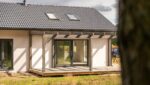
A timber-frame house works differently to a masonry structure. The lighter weight, greater flexibility and complex layering of the partitions make it house acoustics modular here is not an addition on the „finishing” side, but an integral part of the project. W Wascovilla We regard it as an important performance parameter, on a par with thermal performance and airtightness.
Acoustic comfort is the result of many decisions being made well before the panels are installed. This avoids situations where acoustic improvements require costly modifications later.
Mass, stiffness and elasticity - three variables that define the behaviour of a partition
Each partition in a frame house is a dynamic system. What matters is the mass of the skin, the stiffness of the structure and the flexibility of the separating layers. At Wascovilla, we design these relationships so that they dampen vibrations instead of amplifying them. The choice of the type of sheathing, its cross-layer arrangement, the thickness of the infill and the nature of the inner layers has a direct impact on how much acoustic energy will be absorbed in the structure.
The right configuration can quiet the room by several decibels, which users experience in a very realistic way.
Lateral transfer - the invisible enemy of comfort
Even the best partition can lose its properties if sound „misses” it laterally. In timber-framed houses, limiting lateral transmission through proper decoupling of nodes plays a crucial role.
Our specialists pay attention to details that are often missed in traditional construction. These include acoustic strips underneath profiles, proper spacing of sheathing, control of stiffness in floor-to-wall and wall-to-wall joints and elimination of hard bridges that would become conductors of vibration. Such measures build a uniform system that maintains its performance regardless of changes in load or structural performance over time.
Sealed installations and penetrations in a frame house
Noise can penetrate through point weaknesses, so in designing our modular homes We plan installation routes so that they do not disturb the acoustic layout of the partition. We seal installation transitions with elastic joint sealants and avoid close proximity of ventilation and drainage ducts to quiet rooms. We install equipment boxes in a way that minimises local stiffness.
Such seemingly minor decisions often determine in practice whether sound will be heard on the other side of the wall.
Ceilings - the element with the greatest potential for acoustic loss
In frame construction ceiling is a sensitive area. This is where horizontal, vertical and impact vibrations meet. At Wascovilla, we use layering systems that combine the flexibility of the timber structure with diffuse mass and functional decoupling.
Additional sheathing, flexible sub-floor layers and precise beam joints make the ceiling work stably, absorbing impacts instead of transmitting them. It is in the ceiling that the difference between a well-thought-out and a routinely executed design is most easily seen. Inadequate solutions quickly become apparent in everyday use.
Why details are more important than the „thickness of the wall”
In timber-frame construction, there is no single element that alone provides acoustic comfort. The effect is determined by a series of consistent solutions: from the configuration of the layers and the mass, to the way the screws are fixed, the expansion joints and the quality of the infill.
As manufacturer of modular homes We regard such details as an essential component of the design. They are what translate into the real experience of the residents - silence, privacy and the absence of persistent vibrations.
Thoughtful acoustics are a comfort that works
A timber-framed house offers tremendous opportunities for acoustic design. There is one condition: it has to be designed consciously. Therefore, in Wascovilla Every partition, every node and every section of the installation is analysed with regard to sound. As a result, the final result is not a collection of random solutions, but a consistent system that provides users with a calm, comfortable living environment.
In practice, this means ready-made house project, in which sounds are naturally attenuated and not masked by additional layers. Comfort is ensured by construction, not by adjustments made after the fact. If you would like to find out more about solutions to ensure adequate sound insulation in our homes, please contact us. We look forward to a no-obligation discussion.