
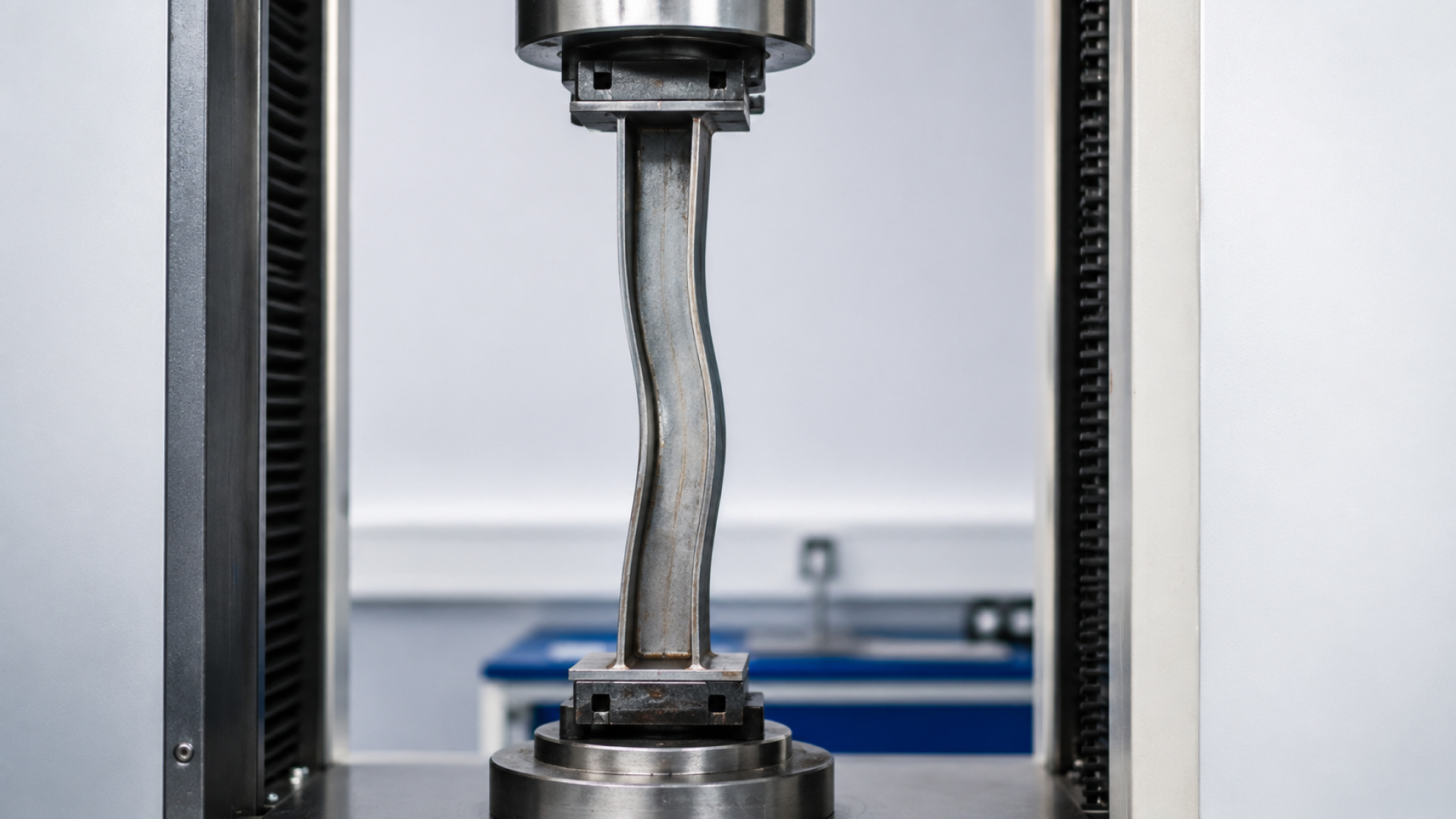
Buckling of a structural member This is the loss of stability of a slender member under compressive forces. This phenomenon involves a sudden change in the shape of a member, most commonly through lateral buckling, even though the stresses in the material may still be below its ultimate strength. This phenomenon primarily affects slender members: columns, bars, bolts, and the compressed chords and cross-braces in trusses.
The risk of buckling depends, amongst other things, on the length of the member, the way it is supported, the shape of its cross-section and the properties of the material. The greater the slenderness of a structural member, the greater its susceptibility to loss of stability under compression. For this reason, buckling is taken into account in the design calculations for steel, timber and reinforced concrete structures. A member may lose its load-bearing capacity before the material even approaches its ultimate strength.
In timber structures, the buckling of a structural member is a significant factor wherever slender members are subjected to compression, e.g. in trusses prefabricated roof trusses or in the studs of the wall framework. They are selected so that the buckling length and cross-section correspond to the forces being transmitted. This phenomenon is counteracted by increasing the cross-section, shortening the buckling length, or introducing supports and bracing to restrict the freedom of deflection. In roofs, this function is performed, amongst other things, by roof trusses, which stiffen the structure and prevent the compressed members of the trusses from losing stability.


