A timber-frame house is not a choice based solely on square footage. Equally important are the proportions of the body, the functional layout, the relationship to the plot and the daily ergonomics of use. Our popular house designs „Seagull” and „Breeze” fall within a similar area range, but represent two different approaches to housing.
Both solutions were developed with the intention of year-round houses, built as permanent and rationally designed buildings rather than seasonal leisure facilities. The differences between the two are mainly due to the architectural form and the use of volume.
„Seagull” - single-storey house with a clear layout
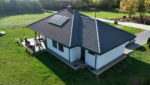
„Seagull” is a single-storey timber-frame house with a compact, classic body. The entire functional programme is placed on one level, which simplifies communication and organises the daily use of the house. No stairs means that there are no split floors and therefore easier access to all rooms.
The interior layout is based on a clear separation of zones:
- living area centred around the living room with kitchen,
- a private area with bedrooms,
- technical and economic facilities.
This scheme works well where the house is intended to provide a clear layout and simplicity of arrangement. The single-storey form makes it possible to design both the living zone and the bedroom with direct access to the garden, which makes it possible to make better use of the plot and ensure that the house's interior has a coherent contact with its surroundings.
On the structural side, the „Seagull” is based on a simple, regular body and an uncomplicated load-bearing system. This facilitates the prefabrication of the elements and efficient assembly on site.
„Breeze” - open space with high living area
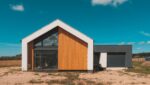
The „Bryza” house is a completely different approach to a building of similar size. Lump follows the form of a modern barn, with a clearly marked ridge and high space above the living area. Part of the living area has been moved to the mezzanine, which changes the perception of the interior.
The height of the rooms plays an important role in the „Bryza”. The living room is not enclosed by a ceiling at standard height, but opens up to the roof. Mezzanine acts as an additional usable space that can be used as a work zone, relaxation area or bedroom. This layout:
- reduces the development area,
- makes better use of the building's volume,
- gives greater freedom of arrangement.
Modular house „Breeze” works well on plots of limited width or where the effect of space and light is important. The large glazing and open form of the interior reinforce the house's relationship with its surroundings.
Differences that matter in everyday use
Although both designs of year-round houses have similar floor space, the way it is used is different.
In the „Seagull”, all home life is concentrated on one level. It is a house with a structured layout, easy to organise and comfortable for long-term use.
„Breeze” offers greater variability of space. The mezzanine and high living room introduce a vertical functional division. This can be an advantage for those looking for a clear differentiation of zones, but requires a conscious approach to the arrangement.
Differences also arise in operation:
- The ground-floor „Seagull” promotes simpler communication and easier access to all rooms. It works well for people with reduced mobility,
- „Breeze” makes better use of daylight thanks to its large glazing and gives the feeling of more space for a similar square footage.
A timber-frame house to suit the plot and lifestyle
The choice between „Mewa” and „Breeze” is also worth considering in the context of the plot.
- The seagull fits in well with plots of larger size and regular shape.
- „Bryza”, thanks to its compact body and smaller footprint, is a advantageous solution for houses on narrow plots or larger plots, but with challenging terrain.
Equally important are the habits of the householders. Those who value a simplified organisation of the house are more likely to find themselves in the ground floor layout of the „Mewa”. On the other hand, those who expect a clear division of functions and an open living space usually lean towards the „Breeze”.
Informed choice instead of compromise
Both the „Seagull” and the „Breeze” are house designs in timber-frame technology designed as full-fledged year-round buildings. They differ not in quality or purpose, but in the way they think about space. W Wascovilla We offer both solutions because they respond to the different needs of investors and the different conditions of plots of land.
It is not a question of which design is „better”, but which one fits better with a particular way of living and using the house.