Both in traditional and modular construction, the external wall is responsible for limiting heat loss and the actual energy efficiency of the building. Among other things, its design determines how much heat stays inside, how the building reacts to temperature changes and what the real heating costs will be over the next decades.
Investors often ask about heat transfer coefficient U and rightly so. It is a figure that says more than any marketing slogan. The technical requirements of WT 2021 specify a maximum U for external walls of 0.20 W/(m²K). The exterior wall in Wascovilla homes achieves U = 0.15 W/(m²K) - which is 25% better than required by law. This is not an accidental result. It is a direct result of the designed layering and the materials used.
We know that the mere declaration of a „warm house” means nothing without specific construction solutions. Therefore, when designing the external walls of a modular house, we focus on the actual parameters, the airtightness of the envelope and the durability of the materials used. As manufacturer of modular homes we offer solutions that combine prefabrication with precisely planned layering. In this way, we achieve a predictable and repeatable effect in every building.
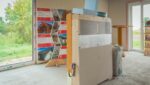
External wall section in a modular house - layer by layer
In our homes, warm walls are the result of a specific arrangement of layers of different materials. Each layer has a specific function and influences the final performance of the partition. Typical exterior wall of a modular house using Wascovilla technology consists of:
- silicone plaster (e.g. KOSBUD), which forms the outer layer of the façade and protects it from the weather,
- reinforced layer (mesh embedded in adhesive), increasing the façade's resistance to mechanical damage and cracking,
- STEICO thermal insulation board Protect dry M with a thickness of 12 cm, which is responsible for the insulation,
- C24 timber frame (45×145 mm), chamber-dried and four-sided planed, which carries the structural load,
- Termex cellulose wool insulation 14.5 cm thick, filling the construction space and reducing heat loss,
- Eurovent N Special 110 vapour barrier on the inside, limiting the migration of moisture into the envelope,
- FERMACELL gypsum fibre board, which provides a durable and resistant substrate for the interior finish, acoustically and mechanically superior to standard plasterboard.
It is this arrangement that makes it possible to achieve the right airtightness and very good thermal performance of the whole envelope.
Why cellulose wool, not mineral wool?
This is a question worth asking directly. In most manufacturers of modular homes They use mineral wool because it is cheaper and widely available. Termex cellulose wool is a more expensive but technically sound choice.
Cellulose wool is made from processed cellulose impregnated with boron salts. Its superiority over mineral in modular technology is due to several features. First of all, it is blown in under pressure. This eliminates the risk of voids and thermal bridges in places that are difficult to reach, e.g. joints, corners, installation transitions. Mineral wool laid by hand has to be fitted into every space, so any mismatch is a point through which heat escapes.
Cellulose also has a higher heat capacity than mineral wool - it accumulates heat and releases it more slowly. As a result, it stabilises the temperature inside the building with external fluctuations. In summer, this means slower heating up, slower cooling down in winter.
Mineral wool soaks up moisture and, once damp, loses its insulating properties permanently. Cellulose is vapour-permeable and deals with moisture in a different way - it absorbs it and gives it back without damaging the structure, as long as the whole partition is designed correctly.
Airtightness more important than insulation thickness
Insulation thickness and U = 0.15 W/(m²K) alone do not guarantee the result. What matters is whether the entire envelope is airtight and whether the layers have been connected correctly. And in timber-frame construction, leakage is more common than in brickwork - at every vapour barrier penetration, at every joint between modules, at a window embedded in the wall.
Prefabrication solves this problem differently from traditional construction. Holes for installations, joints and installation passages are prepared in the factory, before installation, rather than on site, where every adjustment is an improvisation. The continuity of the vapour barrier is verified before transport. There is no room for „fiddling” with details on site.
As manufacturer of modular homes we pay particular attention to:
- vapour barrier continuity,
- accuracy of connections between prefabricated elements,
- elimination of thermal bridges in critical areas,
- repetitive execution of each wall.
This is why modular homes can achieve better results in the Blower Door airtightness test than equivalent traditionally built houses - even with similar materials.
The wall as part of the system - not a separate problem
The external wall does not function in isolation from the roof, windows and foundation. The best insulated wall with a thermal bridge at the window or at the connection to the ceiling loses much of its value. This is why every modular house project, which we later realise as a manufacturer, must be adapted to the prefabrication technology. So that all partitions (wall, roof, floor, joinery) are treated as a single system.
U = 0.15 W/(m²K) of the wall only makes sense if the roof has a sufficiently low coefficient, the windows are matched to the parameters of the envelope and the joints between the modules are airtight. W Wascovilla we design the walls as part of this system and not as a separate problem to be solved. It is their combined performance that determines the thermal balance of the building, the stability of the internal temperature and the actual energy demand.
See the modular home up close
If you are planning to build a house and would like to see what a live wall cross-section looks like - come to the show house during Wascovilla's Open Days. You can touch the materials, see how the layers are put together and ask about specific solutions. We will announce the dates and location on a regular basis on our social media and homepage.