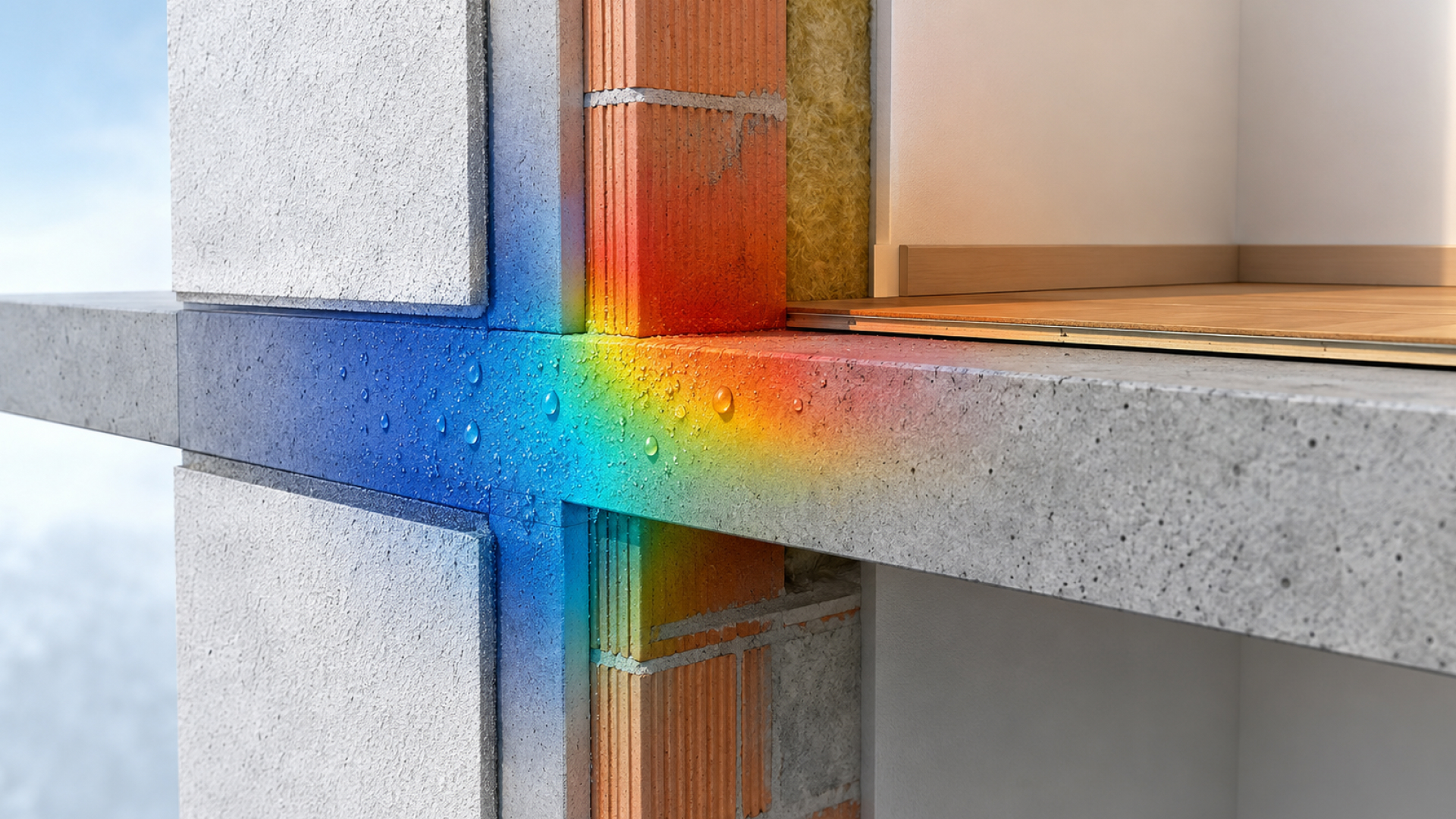
A moisture bridge is a point in a partition or at the junction of structural elements where moisture accumulates or penetrates more intensely than in adjacent parts of the building. In practice, it rarely occurs on its own. It is most often associated with a thermal bridge, as it is precisely in areas with a lower surface temperature that water vapour condenses most easily.
The mechanism usually boils down to one of two scenarios. In the first, the surface of the partition is locally cooler; the temperature drops below the dew point, and the water vapour in the air condenses. In the second, water enters the partition through a breach in the damp-proof course or a poorly executed detail and remains there instead of being drained away. Both scenarios lead to the same result. The material becomes damp, loses its insulating properties and, over time, becomes a breeding ground for mould and fungi.
W frame houses Such bridges occur in recurring locations. They appear where the wall meets the foundation when the horizontal waterproofing fails, and around window and door frames where the fit is not airtight. They also occur where services pass through partitions, and wherever the vapour barrier or wind barrier has been breached and not resealed. Structural timber is sensitive to moisture, so in this construction method, checking these details is even more important than in masonry structures.
To minimise the risk of this occurring, appropriate design, careful execution of structural details and the maintenance of the continuity of damp-proof and thermal insulation are required.