
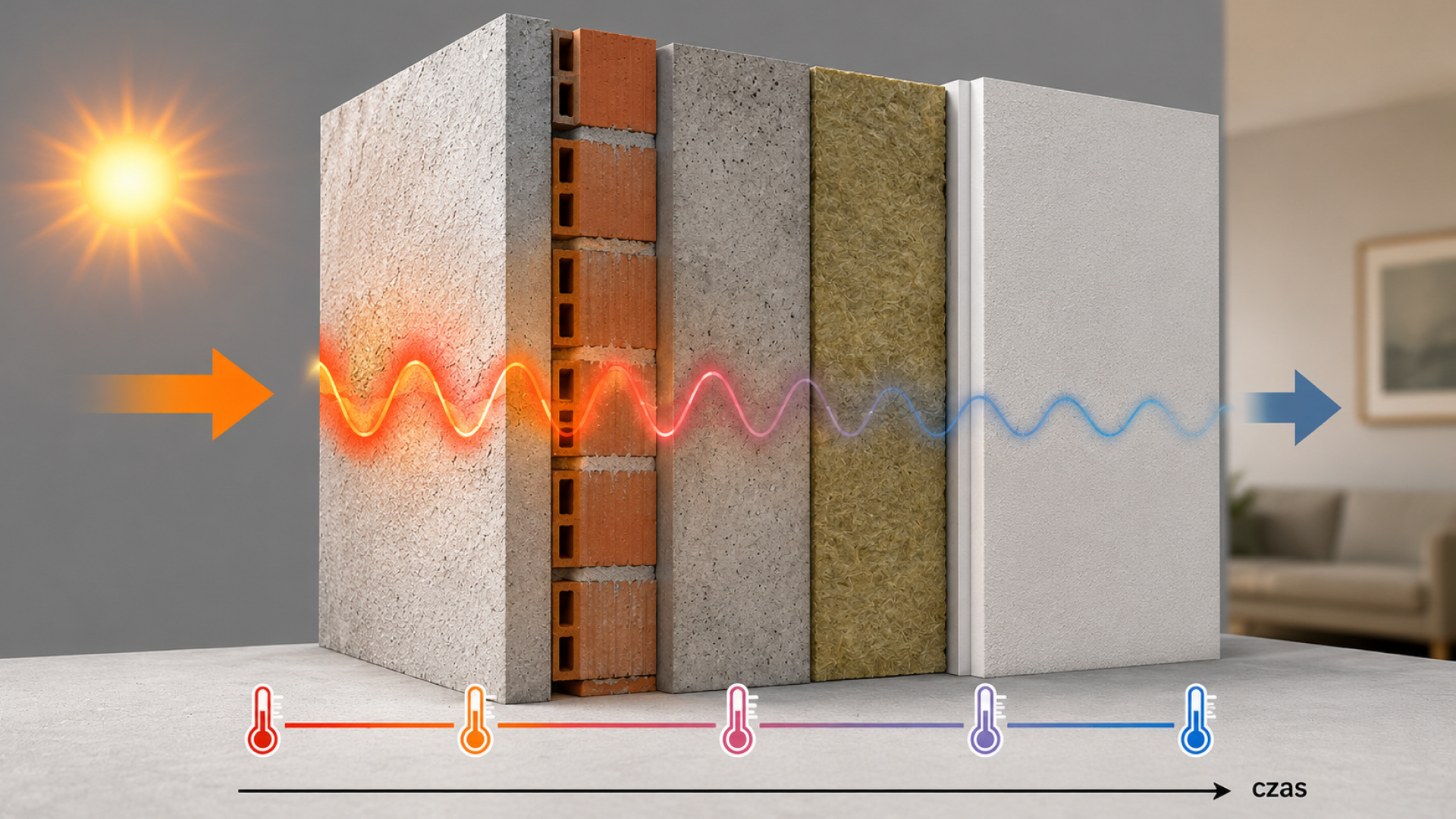
The heat capacity of a building element is the amount of energy that a wall, ceiling or roof can store when the temperature rises. The greater the mass of a partition and the higher the specific heat capacity of its materials, the more heat it can store. This property applies to the partition itself, rather than the entire building, and is directly determined by the materials from which the partition is constructed.
Three factors determine the value of this parameter: the mass per square metre of the partition, the density of the materials used, and their specific heat capacity – that is, their ability to absorb energy. Concrete, brick and screed have a high heat capacity, whilst lightweight materials such as timber, wool and cladding boards have a much lower one. Two walls with the same heat transfer coefficient may therefore differ in their heat capacity. It all depends on how much their core weighs.
Building frame houses This has a tangible significance. A stud-frame partition is, by design, lightweight, so its heat capacity is lower than that of a brick wall of similar thickness. In a lightweight structure, the main heat-storing mass is not contained within the walls, but rather in the foundation slab and the screed with underfloor heating. In practice, these act as a thermal buffer. Thermal comfort in a timber-frame house is therefore achieved differently to that in a brick-built house: through low U-values of the partitions, airtightness and heat recovery, whilst thermal mass is incorporated where it is actually needed, namely in the floor.
This parameter should be considered alongside two related concepts and is taken into account as early as the design stage of external and internal partitions. The fact that a partition accumulates heat and releases it with a delay is described by thermal accumulation. In turn, the resulting delay in the interior’s response to changes in outside temperature is known as thermal inertia. The heat capacity of the partition is a derived quantity, from which both these phenomena arise.


