
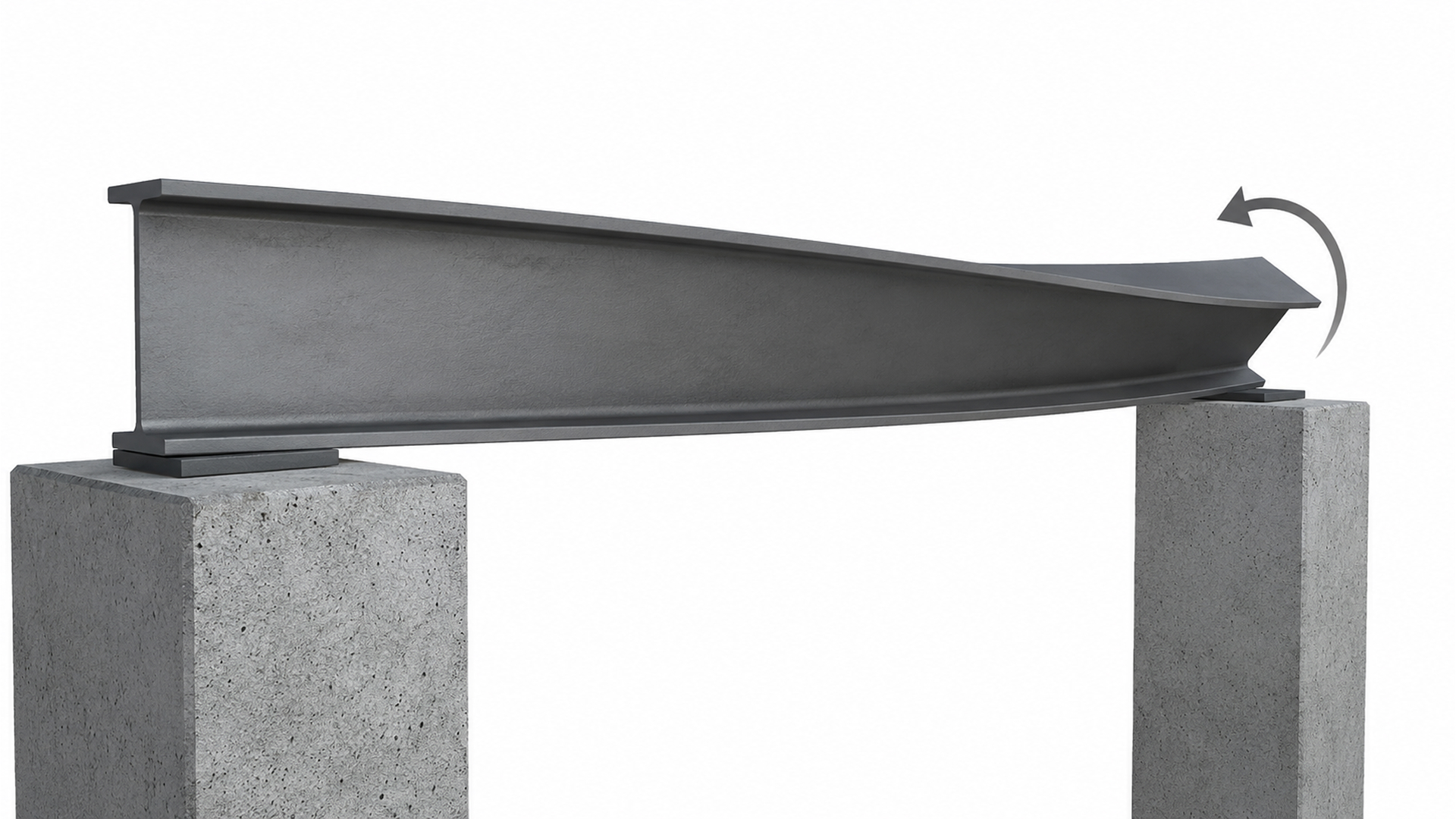
Beam buckling is a loss of stability in a structural member, characterised by the simultaneous lateral bending and torsion of the beam under load.
This phenomenon occurs most frequently in slender beams subjected to bending, when the compressed flange lacks adequate lateral support. As a result, instead of deforming solely in the plane of the load, the beam begins to change its spatial position. This leads to a reduction in its load-bearing capacity.
A sprain should not be confused with buckling, which relates to axially compressed members such as columns and bars. Warping occurs in flexural members, i.e. beams, and always combines lateral deflection with torsion. The common factor is slenderness. It is this, together with how well the member is braced, that determines everything.
The risk of a beam buckling depends, amongst other things, on the length of the member, its slenderness, the shape of its cross-section, the method of support, and the type and location of the applied load. The longer the beam and the weaker the stiffening of the compression flange, the greater the likelihood of this phenomenon occurring. Buckling is taken into account when designing not only timber structures but also steel ones. It is also important in the case of other components subject to bending.
Counteracting this phenomenon essentially involves restricting the lateral movement of the compressed band. This is achieved by bracing, tie-beams and additional lateral supports. In ceilings and roofs, it is not uncommon for the decking itself and the battens to stiffen the beams along their entire length. In frame construction This requirement is taken into account at the design stage when selecting the spacing and cross-section of the C24 timber beams and the arrangement of bracing within the roof structure.


