At Wascovilla, we know that house construction should be durable and energy-efficient, and the design itself should meet contemporary utility and aesthetic needs. That is why we combine timber-frame and modular technology, achieving solutions that are modern, functional and economical to maintain.
Frame technology is currently one of the most dynamically developing solutions in single-family housing. Usually based on a timber substructure, it allows for precise detailing, high thermal insulation and rapid installation.
Frame technology - timeless design and customisation
The timber-frame technology offers a great deal of freedom in shaping the massing and layout of the rooms. Walls do not require a massive structure, so open living spaces and wide glazing can be created without losing strength parameters. W Wascovilla We design houses that combine simple form with maximum utility. We develop functional layouts to suit a variety of lifestyles - from compact homes for couples to larger family buildings.
An example of this approach is house Breeze. This single-storey project with mezzanine, in which the living area opens up onto the garden through large glazings. Thanks to the timber-frame technology, it was possible to achieve a high living room space, which in traditional brick construction would have required much larger structural sections. The interior of the Bryza was designed to combine the kitchen, dining room and living room into one functional area. The mezzanine serves as a recreational or bedroom area, demonstrating the flexibility of this type of construction.
Practical minimalism in single-storey homes
House designs - Amber and Dune, in turn, are examples of modern single-storey buildings, which use timber-frame technology to create compact, economical and low-maintenance structures. In Bursztyn, the day and night functions have been clearly separated and the layout of the rooms is based on a communication axis leading to the living room with access to the terrace. The well-thought-out layout allows for efficient use of space. Each room has adequate access to daylight and the technical rooms are grouped in one part of the building.
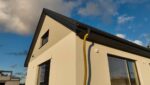
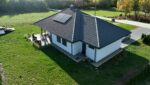
The dune, on the other hand, is house design modular with a more compact floor plan and calm visual character. With its simple body, pitched roof and subdued facade finish, the house fits well on a variety of plot types. Thanks to the use of prefabricated timber-frame modules, construction time was reduced to a minimum and all structural elements are fitted with great precision. This is an example of how timber-frame technology combines economical construction with precision workmanship and high quality detailing.
Durability and energy efficiency of timber-frame houses
At Wascovilla, we pay particular attention to the durability of the construction and the thermal comfort of the users. Frame technology enables the partitions to be filled with materials with very good insulation properties, so that the heat transfer coefficient of the external walls is significantly lower than in traditional construction. In practice, this means less energy consumption for heating and cooling the building. In addition, thanks to dry installation technology, it is possible to carry out work at any time of the year without the risk of the structure becoming damp.
An important element is also durability. A properly designed and protected timber frame has a lifespan comparable to masonry structures. The elements are impregnated and assembled under controlled production conditions, which eliminates workmanship errors. Thanks to this Wascovilla houses retain their performance over many years and require minimal maintenance.
House construction and the aesthetics of modern simplicity
Timber-frame construction offers considerable scope for shaping the external appearance of the building. The masses of our houses are characterised by simple lines, consistent proportions and natural finishes. In the Bryza, Bursztyn and Wydma projects we use wooden façade accents, which emphasise the structural character of the building and refer to nature. The interiors, meanwhile, are based on layouts that ensure maximum light and comfort.
Modern design in frame technology is not about showy forms, but about the logical interplay of space and function. The layout of walls, installations and modules is planned at the design stage, avoiding haphazard solutions. In this way, every element, from the structure to the finishing details, forms a coherent whole, where quality and precision count.
The direction of contemporary construction
Frame technology is increasingly being chosen by builders who are looking for an alternative to traditional construction. It allows for quick construction, predictable costs and easy future expansion. At Wascovilla, we see it as a natural direction for construction that is efficient, modern and environmentally friendly. Our projects show that it is possible to combine technical rigour with high aesthetic value, and frame house can be both sustainable, comfortable and individualised.
The Bryza, Amber and Dune houses are just some of our proposals that illustrate how timber-frame technology is changing contemporary architecture. It makes a building not only a comfortable place to live, but also an example of conscious design in which every detail is justified.