
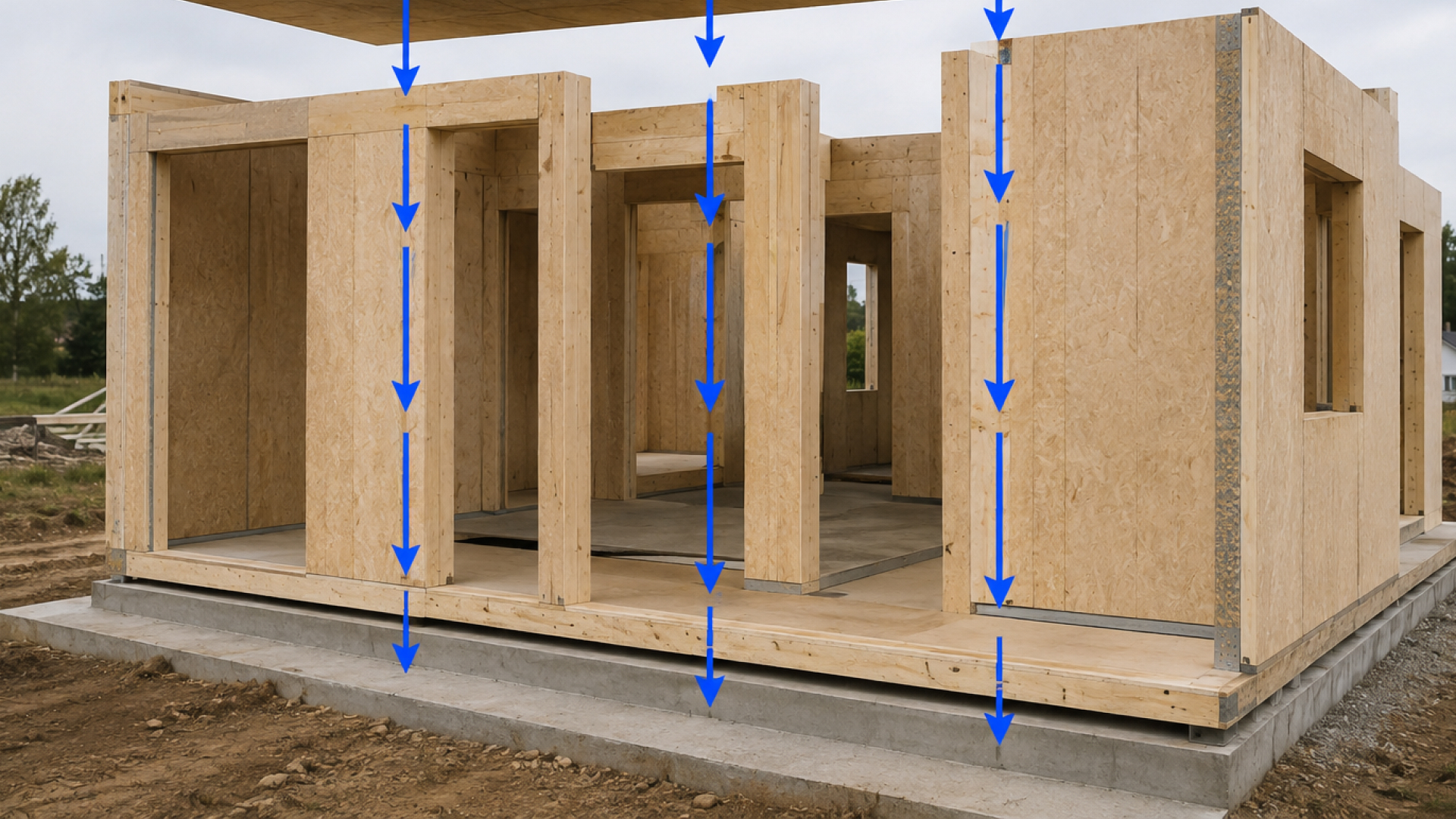
The load-transfer path is the way in which the forces acting on a building are transferred through the individual structural elements down to the foundations and the ground. No load simply disappears. The weight of the roof, snow or the pressure from the ceiling must be able to travel downwards continuously, as it is only the ground that provides the final support for the entire structure.
This path is a sequence of interlinked elements, each of which takes the force from the previous one and transfers it onwards. From the roof to the load-bearing walls and beams, from there to the columns, then to the foundations and the ground. Along the way, the structure must transfer both dead loads, resulting from the weight modular house, as well as variable factors (e.g. snow, wind). The distribution of these forces across individual components is verified using a static diagram.
A correctly designed load-transfer path ensures that forces are distributed evenly and that the entire structure operates safely. An interruption or incorrect configuration of the load-transfer path leads to excessive deformation. This can result in damage to structural elements and, in extreme cases, a loss of stability of part or all of the structure. For this reason, the analysis of load transfer is one of the fundamental aspects of structural design.
In a timber-framed house, this path is exceptionally clear. Vertical loads are transferred from the roof trusses via the wall plate to the posts of the load-bearing walls, and from there to the foundation beam, the foundation slab and the ground. Horizontal forces caused by the wind follow a separate path. These are absorbed by the panels formed from the wall and roof cladding, which provide spatial rigidity to the building and transfer these loads downwards to the foundations. It is precisely the continuity of both these paths – vertical and horizontal – that ensures the lightweight timber structure functions safely.


